For the last two years, the story at Meta Connect has been the slow march toward AR glasses — Orion, the holographic prototype Meta paraded in 2024, was meant to be the future. So the most telling thing about last night’s keynote wasn’t what Meta showed. It was what it didn’t. Orion went unmentioned. Instead, the headline device was a pair of VR glasses — and after a year of everyone declaring VR dead in favour of AI eyewear, that’s a genuine plot twist.
The star: Meta VR Glasses
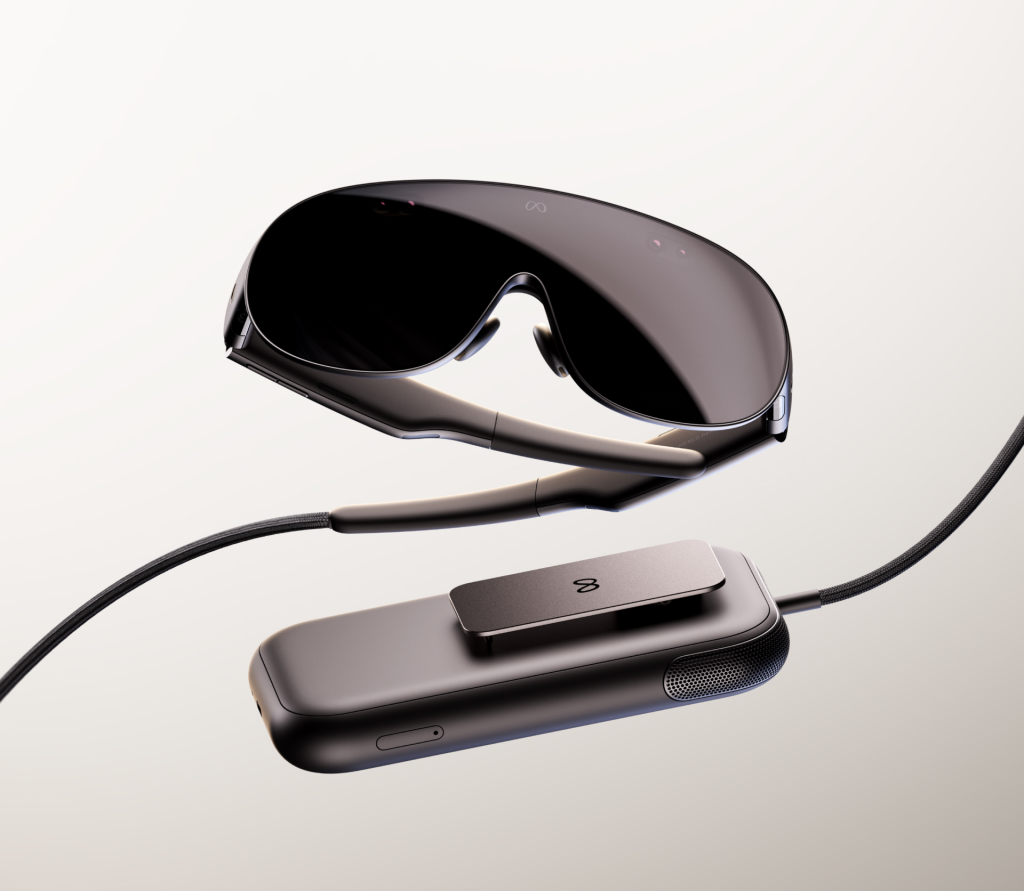
Image: Meta
Meta’s big reveal was, simply, “Meta VR Glasses” — a radically slimmed-down headset that weighs around 100 grams, roughly five times lighter than a Quest 3. It gets there with magnesium-alloy frames, pancake lenses, and a trick we’ve been tracking for weeks: the compute is offloaded to a separate tethered puck (running Qualcomm’s new Snapdragon Reality Elite chip), keeping the thing on your face feather-light.
If that architecture sounds familiar, it should — this is almost certainly the device that leaked from Meta’s own firmware earlier this month under the codename “Phoenix.” Meta never said that name on stage, but the slim, tethered, glasses-like profile matches exactly. Phoenix, it seems, has hatched as a product.
The specs are serious: a 5K display, full-colour passthrough, Dolby Vision and Atmos, IMAX Enhanced certification, hand-gesture control, and 75 games at launch including Xbox Cloud Gaming support. It’s priced at $1,300 and ships Spring 2027, so this is a preview you can pre-order into rather than buy next week.
The glasses blitz
If the VR headset was the surprise, the smart glasses were the volume play — Meta launched an entire wall of them:
- Ray-Ban Meta Gen 3 — the mainstream camera glasses, now slimmer with a dedicated Meta AI button, a 6-mic array, 12MP/3K video and a 9-hour battery. From $449, available today. There are even Kylie Jenner and Blackpink Lisa special editions.
- Ray-Ban Meta Audio — the camera-free pair (this is the “Luna” that leaked). No camera, just AI voice, audio and calls, at $349, shipping October 13. This is Meta’s direct answer to the privacy backlash — glasses it can sell without anyone asking what they’re recording.
- Meta Glasses (own-brand) — a cheaper in-house line starting at $249 (the “Adventurer”), plus a limited “Fury” edition, from October 23.
- Meta Ray-Ban Display — the heads-up-display glasses finally go international, with UK pricing at £749 and pre-orders opening across Germany, France and Italy.
There’s also a new hearing enhancement feature across the glasses range ($149 one-off), aimed at boosting speech in noisy environments.
The oddest reveal: Muse Charm
Meta also teased Muse Charm — a keychain-sized gadget housing its Muse AI agent, complete with a small display, speakers, mics and a fingerprint sensor. Details were thin, but the idea of a standalone AI companion you clip to your keys is a curious sideways step. More is promised later this year.
Our take
At AugmentedReality.com, what strikes us most is the quiet retreat from the AR-glasses hype. A year ago, Orion was Meta’s north star — proof that true augmented reality was coming. Last night, Orion wasn’t mentioned once, and the marquee hardware was a VR headset. That’s a meaningful shift in emphasis.
We don’t think it means AR is dead — the Ray-Ban Display expansion shows Meta still inching displays onto your face. But it does look like Meta has quietly re-sequenced its roadmap. Full AR glasses are hard, expensive and years out, so the company is banking the wins it can ship now: cheap AI audio glasses for the mainstream, and a genuinely impressive lightweight VR headset for the enthusiasts. VR isn’t making a comeback so much as being repositioned as the deliverable half of Meta’s ambitions while AR stays in the lab.
The camera-free Ray-Ban Audio is the other tell. Launching a pair of glasses whose main selling point is what they can’t do is a remarkable admission of how badly the privacy conversation has gone for Meta. A year ago the pitch was “look what our glasses can see.” Now, for one product at least, it’s “don’t worry, these can’t see anything.” That’s not a small change in tone.
Orion will presumably return when the technology is ready. But for 2026, Meta’s message was clear: the future it’s actually selling you is a 100-gram VR headset and a pair of glasses that mind their own business.