Most of the AR glasses that dominate the headlines share one frustrating trait: you can’t actually buy them yet. Meta’s VR Glasses are a 2027 proposition. Apple’s headset is years out. Even Snap’s Specs are still “shipping this fall.” Amid all that waiting, XREAL has done something refreshingly concrete — it’s putting proper AR glasses on sale right now.
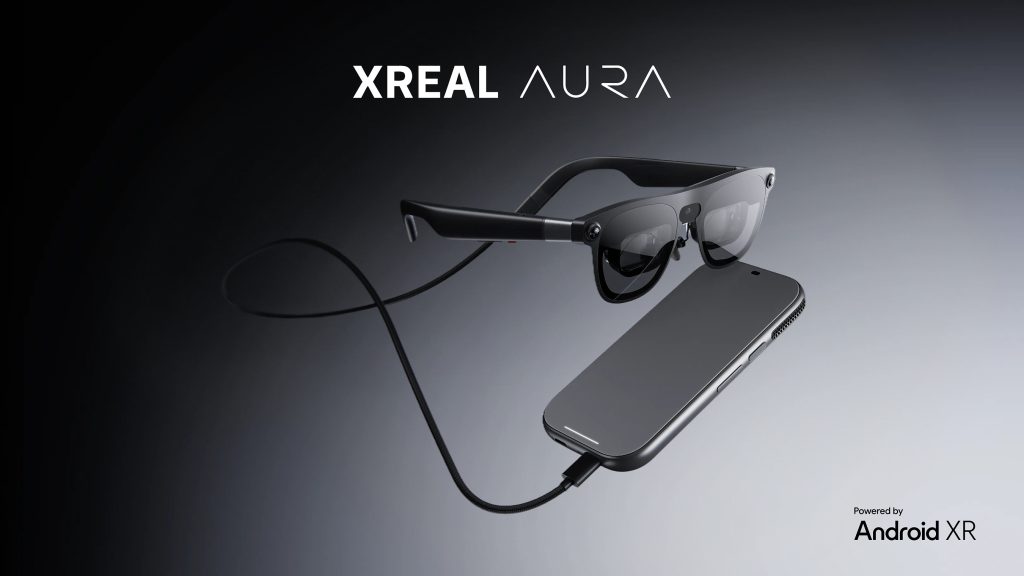
Image: XREAL
The company has announced that its Aura glasses are going on sale, starting at $1,279, with shipping beginning shortly in the US, Canada, Japan and South Korea. Pre-orders are open to existing reservation-holders first, with general availability following in the coming weeks and more markets arriving in 2027.
What the Aura actually is
The Aura is an optical see-through AR device — and that “see-through” part matters. Rather than filming the world with cameras and replaying it on internal screens (the passthrough approach of a Vision Pro or Meta’s VR Glasses), the Aura lets you look at the real world directly, with digital content layered over your actual view. That’s closer to the long-held dream of true augmented reality.
The glasses weigh under 95 grams, offer a 70-degree field of view, and come in two sizes. They include precise hand tracking and audio tuned by Bose. The higher-end configuration, with more memory and storage, runs $1,499. In short: a genuine wearable, available in two sizes, that you put on and look through.
The Android XR angle
Here’s where it gets strategically interesting. The Aura runs Android XR, Google’s operating system for this new category, complete with Google Play for apps. It was built in collaboration with Google and Qualcomm, and leans on Google’s Gemini AI and Qualcomm’s Snapdragon Reality Elite chip.
That makes the Aura one of the first Android XR glasses to actually reach customers’ hands — ahead of Samsung’s Intelligent Eyewear, due next month, and Google’s own glasses expected later. The significance isn’t just one product; it’s that the Android XR ecosystem is now real, with shipping hardware and an app store, rather than a platform waiting for devices to run it.
The puck, again
The Aura doesn’t carry its brains on your face. It uses what XREAL calls a split-compute architecture: the glasses tether by cable to a small compute puck that handles the processing, doubles as a trackpad, and clips to a pocket or hangs on a lanyard.
If that sounds familiar, it should. It’s the same core idea Meta is using for its featherlight VR Glasses, and the same approach Apple is reportedly testing for its next headset. When three of the most serious players in the space independently land on “keep the glasses light, move the computer elsewhere,” that’s no longer a quirk — it’s becoming the accepted blueprint for wearable spatial computing.
Our take
At AugmentedReality.com, we think the Aura’s real headline isn’t its specs — it’s the word “available.” While the giants trade roadmap dates and leaked renders, XREAL is quietly doing the unglamorous, important thing: actually shipping see-through AR glasses to paying customers, this year. That matters, because a category doesn’t mature on announcements; it matures on devices people can put on their faces and live with.
The price positioning is smart, too. At around $1,279, the Aura sits in a sensible middle ground — well above the $349 Ray-Ban Meta audio glasses, but comfortably below Snap’s $2,195 Specs. It’s priced for serious enthusiasts and early adopters rather than the mass market, which is exactly the right audience for a first proper Android XR device.
Most of all, the Aura is further proof of the pattern we keep returning to: the industry is converging. See-through optics, Android XR as the shared platform, a tethered compute puck to keep the glasses light — the same ideas are turning up across Meta, Apple, Samsung, Google and now XREAL. The difference is that while most are still promising, XREAL is delivering. And in a category that has traded on hype for years, actually turning up with a product you can order is its own kind of statement.