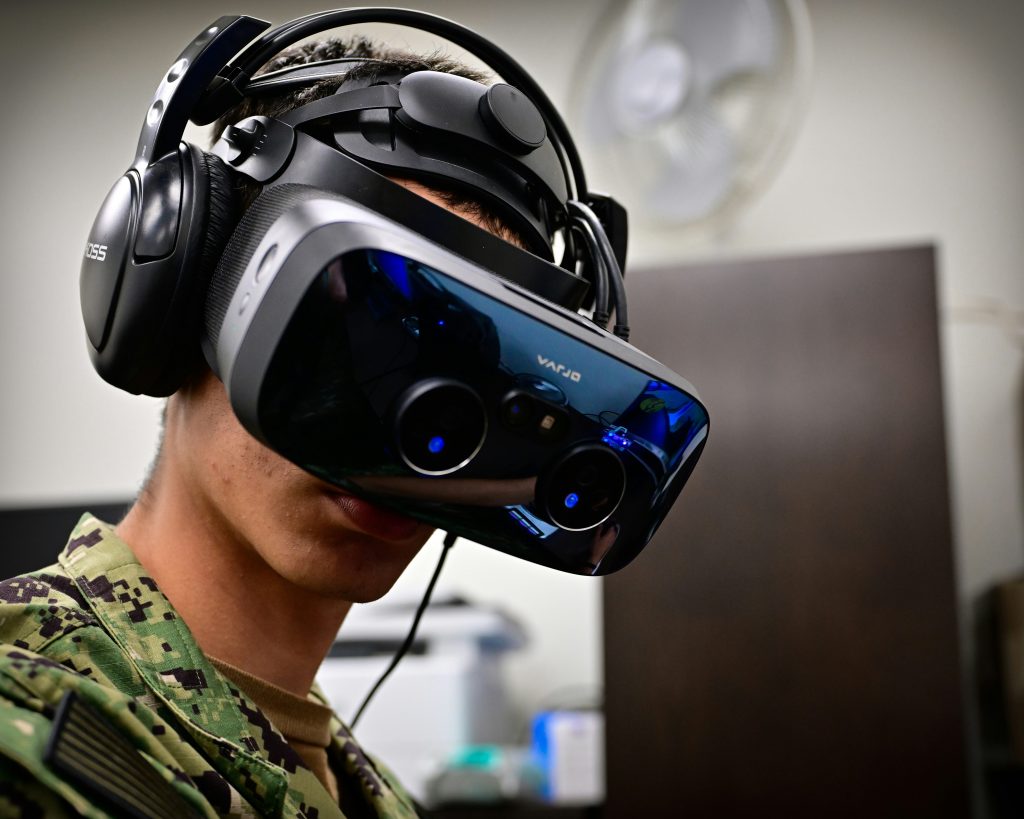
Augmented reality has found applications across almost every sector of human activity. But perhaps nowhere is its potential more profound — or more consequential — than in military and defence applications.
From soldier training to battlefield situational awareness, AR is reshaping how modern armed forces operate, train, and make decisions under pressure.
Soldier Situational Awareness
In combat, information is survival. A soldier who knows where their colleagues are, where the enemy is, and what the terrain ahead looks like has a decisive advantage over one operating blind.
AR headsets and helmet-mounted displays can overlay this critical information directly into a soldier’s field of vision. GPS positions of friendly forces appear as icons on the battlefield. Drone footage is overlaid onto the real environment. Navigation routes are displayed without the need to look down at a map.
The US Army’s Integrated Visual Augmentation System (IVAS), developed in partnership with Microsoft using HoloLens technology, is the most advanced example currently in deployment. It provides soldiers with a comprehensive AR battlefield picture — enhancing situational awareness while keeping their eyes and hands on their mission.
Military Training
Training soldiers for combat is expensive, dangerous, and logistically complex. Live-fire exercises require vast training areas, significant resources, and carry inherent safety risks.
AR is transforming military training by allowing soldiers to rehearse complex scenarios in realistic simulated environments overlaid onto real physical spaces. A squad can practice urban combat manoeuvres in an empty warehouse, with AR overlaying enemy positions, civilians, and environmental hazards in real time.
This approach dramatically reduces training costs, allows scenarios to be repeated and varied instantly, and enables a level of complexity and realism that traditional training methods cannot match.
Maintenance and Technical Support
Modern military equipment — aircraft, vehicles, weapons systems — is extraordinarily complex. Maintaining it requires highly trained technicians with access to vast amounts of technical documentation.
AR is streamlining military maintenance in the same way it is transforming civilian manufacturing. Technicians wearing AR headsets can see maintenance procedures overlaid directly onto the equipment they’re working on, with remote expert support available in real time. The result is faster maintenance, fewer errors, and reduced dependence on scarce specialist expertise.
Intelligence and Reconnaissance
AR is also finding applications in intelligence and reconnaissance. Analysts can overlay satellite imagery, historical data, and real-time sensor feeds onto physical maps and terrain models — building a richer, more actionable picture of the operational environment.
Forward observers and reconnaissance units can use AR to tag and annotate points of interest in their field of view — sharing this information instantly with commanders and support units in real time.
Ethical Considerations
The military application of augmented reality raises important ethical questions. As AR systems become more sophisticated, they will increasingly be used to support autonomous and semi-autonomous weapons systems — raising questions about human oversight, accountability, and the nature of decision-making in combat.
These are questions that military establishments, governments, and international bodies are actively grappling with. How AR is governed in military contexts will be one of the defining ethical challenges of the coming decade.
The Future of Military AR
Investment in military AR is accelerating globally. The United States, China, the United Kingdom, and other major powers are all developing next-generation AR systems for their armed forces.
The soldiers, pilots, and commanders of the future will operate in an environment where digital information is seamlessly integrated with physical reality — where the fog of war is partially lifted by technology, and where human judgement is supported by unprecedented situational awareness.
Augmented reality will not remove the human from the battlefield. But it will fundamentally change what that human can see, know, and do.
Shop VR Headsets
Experience AR & VR for Yourself
The best headsets available now on Amazon — compatible with the latest AR and VR experiences.
The leading standalone VR headset. Wireless, powerful, perfect for immersive content.
Apple’s spatial computing headset. The ultimate immersive viewing experience.
Sony’s PS5 VR headset. Eye-tracking, haptic feedback and 4K OLED display.
* As an Amazon Associate we earn from qualifying purchases.